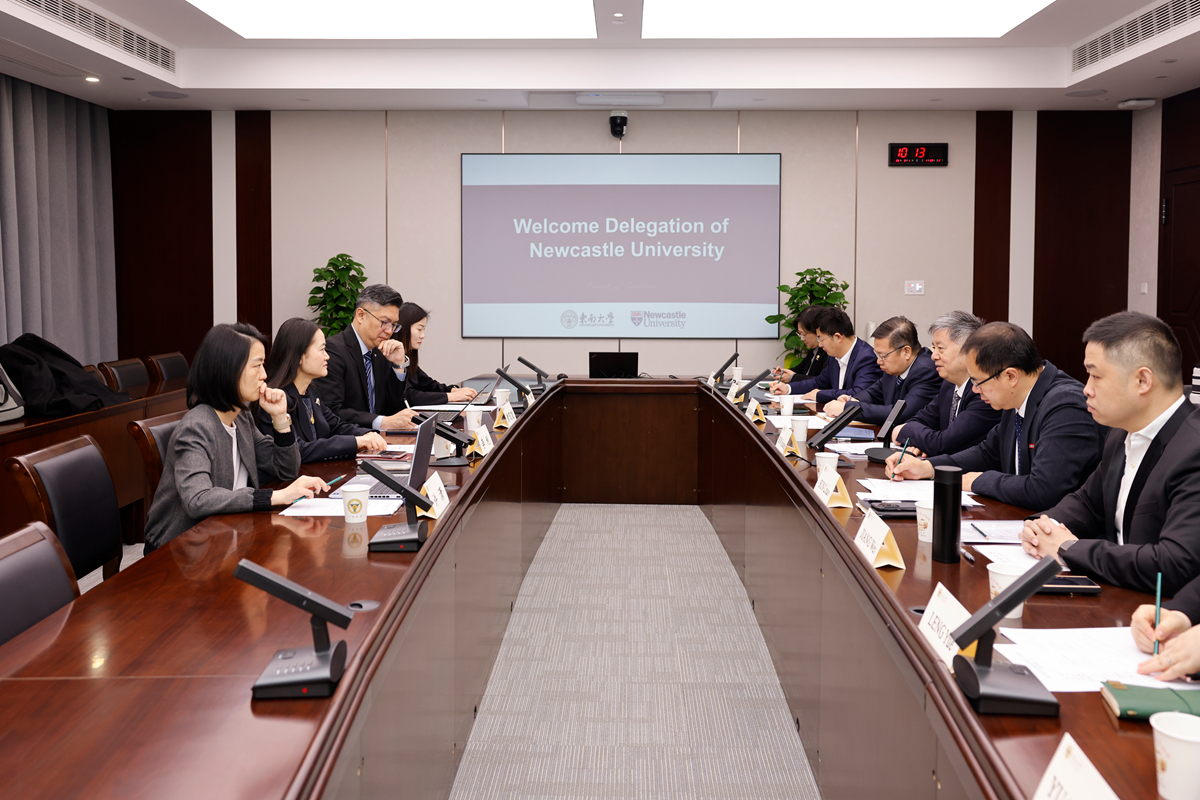
On the morning of March 24, the 2026 Southeast University-University of Manchester Hydropolis Spring School, jointly organised by Southeast University and the Confucius Institute at the University of Manchester (UoM) and organized by the School of Architecture, SEU, kicked off atthe Main Hall, Qiangongyuan Building, SEU. Themed “Transnational Academic Collaboration, Co-creation of Industry Innovation,” the event focuses on Nanjing’s hydrological heritage of intertwined rivers and lakes. It also serves as the opening activity of the “Youth in Jinling – 2026 Nanjing International Youth Exchange Camp.” The event brings together 15 international students from the United Kingdom, the United States, Sweden, Poland, and other countries, along with 14 students from SEU. Guided by Chinese and British faculty, the students will delve into Nanjing’s urban spaces to explore the relationships between urban space, ecological processes and social activity in the hydropolis.

Prof. Li Xiangfeng, Secretary of the Party Committee of the School of Architecture at Southeast University, delivered a welcome address on behalf of the organizers. He expressed his gratitude to the leaders, guests, and Chinese and international faculty and students in attendance. He noted that the School of Architecture at Southeast University and the University of Manchester have strong disciplinary complementarity in urban studies. He expressed hope that this spring school would serve as an opportunity to establish a long-term and stable platform for cooperation and exchange, fostering mutual understanding and friendship between Chinese and British youth through cross-cultural communication, and contributing to the sustainable development of the global human environment.
Prof. Deljana Iossifova, Chair Professorof Architecture and Urban Studies at the University of Manchester and Dean of the Confucius Institute, stated in her address that it was a great honor to gather in Nanjing in the spring. She expressed her gratitude to the staff, partner institutions, and relevant departments in Nanjing for their efforts. In her view, water is a core issue in urban studies and a natural bridge connecting different cultures and academic traditions. She expressed hope that the two universities would use this event as a starting point to pursue further cooperation and exchange, allowing the friendship and collaboration between Chinese and British universities to flow as continuously as water.
Following the opening ceremony, the event featured a series of thematic lectures on “River-Lake Systems and Historical City Conservation” and group ice-breaking sessions. Six scholars and industry experts from Chinese and British universities delivered lectures, exploring the deep connections between water and urban development from multiple disciplinary perspectives, including thinking architecture, water, and infrastructure across scales, Yangtze River conservation, waterfront heritage corridors, morphological evolutionof Nanjing’s Old City, socioecological handling of water landscapes, and land and water as palimpsest. The lectures provided Chinese and international students with a rich academic feast.

After the lectures, Chinese and international students will be divided into mixed groups based on five interdisciplinary and cross-cultural research themes:cultural and historical waterscapes, perception and everyday life, water architecture and topos, environmental governance, and water infrastructure and practices, laying a solid foundation for subsequent collaborative research and creative work. The spring school will last for 11 days, not only building a bridge of communication between Chinese and British youth but also contributing academic insights to the study of the historical and contemporary evolution of water cities. As the opening event of the 2026 Nanjing International Youth Exchange Camp, this spring school uses water as a medium to kick off the year’s international youth exchange activities, helping Chinese and international students experience the pulse of Nanjing through research and learning. It sets a tone of openness, inclusiveness, and the integration of knowledge and action for the camp’s subsequent activities. Outstanding outcomes will also showcase Nanjing’s achievements in the harmonious coexistence of “mountains, water, and city” to the international community, bringing the wisdom of Nanjing’s urban development embodied in its waterways to the world.
Source: School of Architecture
Translated by: Melody Zhang
Proofread by: Gao Min
Edited by: Leah Li