Recently, the team under the leadership of Hao Menglong, a young teacher of the School of Energy and Environment of Southeast University, in collaboration with the University of California, Los Angeles (UCLA) and other units, has developed a new type of insulating aerogel of boron nitride (hBN) with a hollow hole wall structure. Both parties published their research achievement in “Science”.
It is reported that aerogel is a promising new generation of insulation material on the market because of its ultra-low thermal conductivity. However, the aerogels available on the market still have many performance shortcomings in the application to extreme environments such as aerospace. For example, the silica aerogel may increase the spacecraft’s load due to its high density; the graphene aerogel is most likely to get oxidized in the air, therefore, it is difficult to withstand high temperature when the return chamber enters the atmosphere. The boron nitride (hBN) aerogel has effectively solved the shortcomings of traditional aerogel with poor thermal stability, fragility and high density through the hollow hole wall structure. This breakthrough is expected to be widely applied to the aerospace thermal control and energy conservation in buildings, etc..
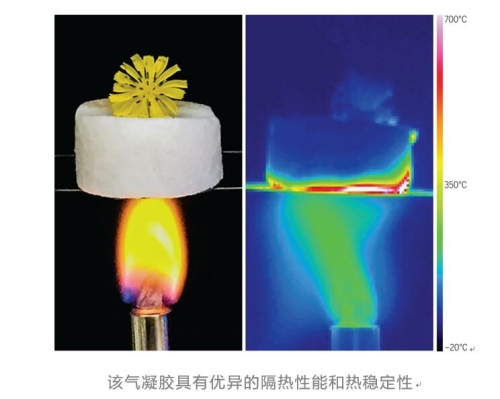
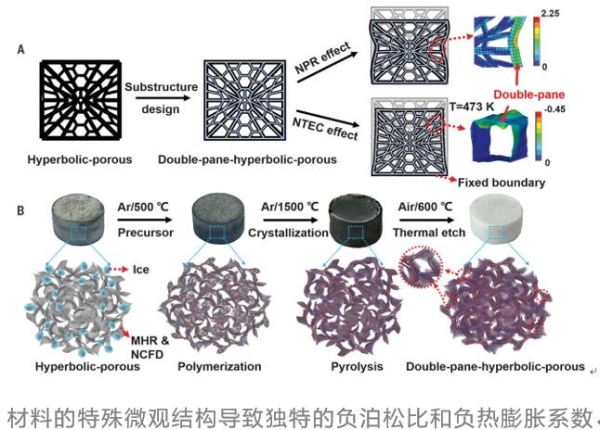
Hao Menglong's research team, starting from the performance objective, rationally designed the chemical composition and the material’s multi-scale structure. First, hBN was selected as the basic constructionunit to achieve high temperature stability in the air; secondly, by using the method of depositing hBN nano-layer on the graphene aerogel template and then etching away the template, a unique hollow-pore wall structure was obtained, which has further reduced the thermal conductivity section and effective thermal conductivity. In addition, by regulating the cooling mode in the aerogel molding process, the sheet-like hBN formed a hyperbolic microscopic arrangement, and thus the material could present a mechanically ultra-stable structure with a negative Poisson's ratio. The material characterization results show that the aerogel structure has indicated excellent performance in various indexes, including extremely low density (0.1mg/ml), high temperature stability (1400°C), ultra-low thermal conductivity (vacuum as low as 2.4mW/m•K), super-elastic (95% deformation), thermal shock stability (275°C/s) and negative thermal expansion coefficient.
Professor Chhowalla from the Department of Materials of the University of Cambridge highly appraised this research achievement in his review article for “Science”. He pointed out that this aerogel has pioneered a brand-new three-dimensional structure with two-dimensional materials, which highlights great potential values for various applications demanding high specific surface area, such as catalytic and electrochemical energy storage. In addition, if further studies can be carried out in terms of reduction of optical absorption rate in the future, such material will be likely to become the main structure of the interplanetary aircraft such as “light sail”. (School of Energy and Environment)
(http://science.sciencemag.org/content/363/6428/723)